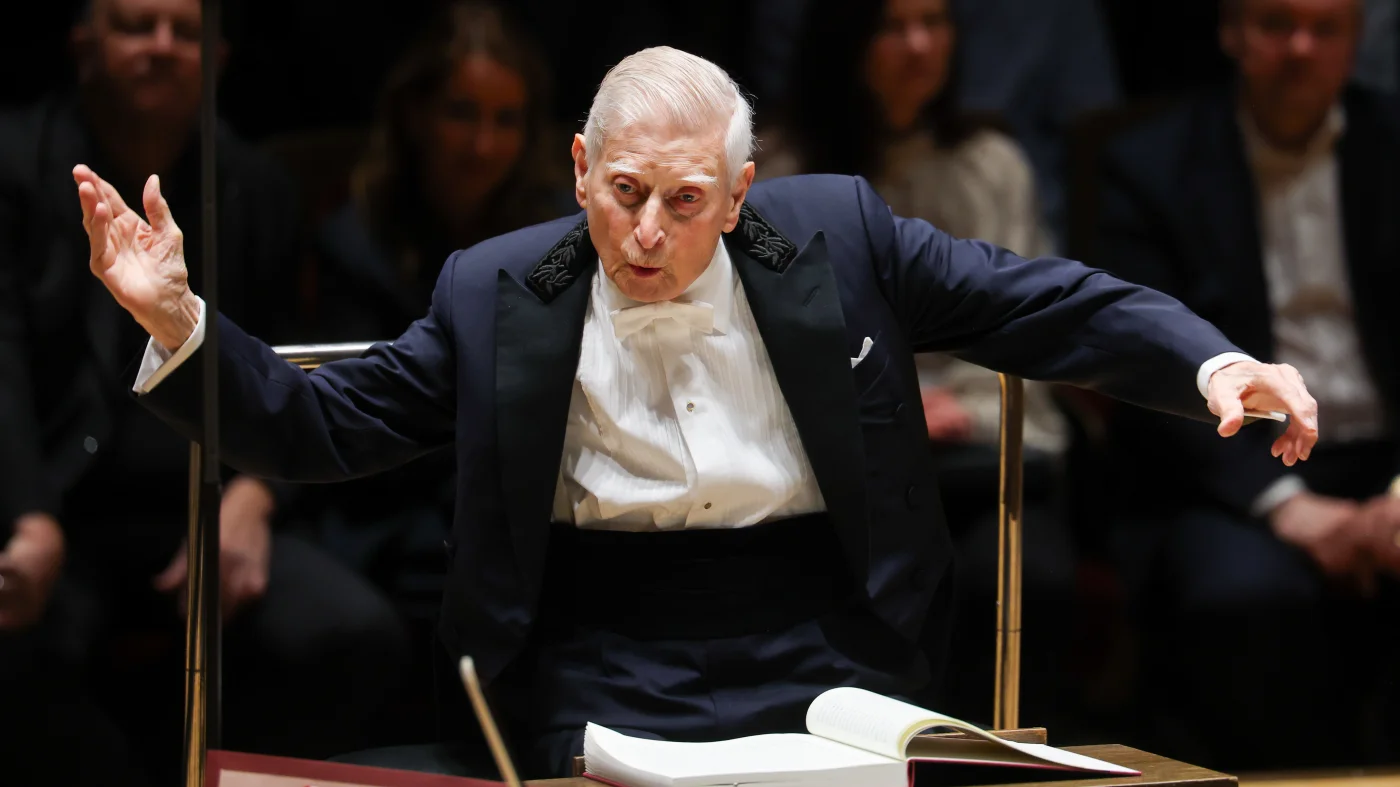
Herbert Blomstedt conducts the Gewandhaus Orchestra of Leipzig in April 2026, at the age of 98. Jan Woitas/picture alliance/Getty Images hide caption Herbert Blomstedt, an American-born, Swedish conductor whose remarkably long career saw him leading many of the world's major orchestras, including the San Francisco Symphony for 10 years, died on Wednesday at his home in Gothenburg, Sweden. He was 99. His death was announced in a statement released by his management company, KünstlerSekretariat am Gasteig. In a profession routinely flush with elderly practitioners, Blomstedt, year after year, retained his title as the world's oldest active conductor. He worked into his late 90s, conducting concerts this year, at the age of 98, with the Detroit Symphony and the Gewandhaus Orchestra of Leipzig, Germany. "Retirement is not a question of age," Blomstedt told the Australian Broadcasting Corporation. "It should be flexible. I just love the music so much that I just can't give up." And he didn't. Blomstedt suffered falls in 2022 and 2023, and an ear infection in 2025, forcing him to cancel performances in Europe and the U.S., but he was undaunted. He resumed adding dates to his schedule, leading the world's top orchestras. In recent years, he conducted while seated at a piano bench. He had plans to conduct a series of concerts with the San Francisco Symphony in May of this year and again in January 2027, both of which were canceled when health concerns got in the way. "The music-making of elderly conductors can sometimes be either lofty or slow, sometimes both," Martin Kettle wrote in The Guardian in 2022. "Neither quality applies to Blomstedt … his conducting in old age radiates both flow and glow. Blomstedt does not force or underline the music, he releases it. But the attentiveness to pulse, phrasing and dynamics are unflagging." Blomstedt brought clear-eyed structural integrity and a strict devotion to the composer's score to wide swaths of orchestral music — and eras — from J.S. Bach to Elliott Carter. But late in his career, he distilled his repertoire down to a few favorite Scandinavian composers and a handful of Germanic staples by Bruckner, Brahms, Schubert, Haydn, Mahler and his beloved Beethoven. He recorded all nine Beethoven symphonies twice, once with the Staatskapelle Dresden, which he led from 1975 to 1985, and later with the Gewandhaus Orchestra of Leipzig, where he was chief conductor from 1998 to 2005. "Both cycles remain beacons of good taste, with a distinctive spiritual power shining through," David Allen wrote in The New York Times in 2022. "That's particularly true of the Fifth [symphony], which may be less brutally violent than under other conductors but has a merciful empathy to its relative restraint." Asked by Allen why Beethoven remains such an obsession, Blomstedt pointed to the humanity in the composer's music. "It can represent the suffering of everyone," Blomstedt answered. "Not only his, but mine. The suffering of today in Ukraine, for instance. That helps it outlive the personal situation of the composer, or the personal situation of the interpreter. It's something that we go through, as humans." Herbert Thorson Blomstedt was born on July 11, 1927, in Springfield, Mass. to Swedish parents, both Seventh-day Adventist missionaries who returned home when Blomstedt was two, settling in Gothenburg. In his youth, Blomstedt learned piano, violin and organ, then fell in love with symphonic music. He memorized the names of orchestra players and when the revered German conductor Wilhelm Furtwängler performed in Gothenburg, the shy young Blomstedt asked the maestro for an autograph. In 1945, Blomstedt entered the Swedish Royal College of Music where he began to study conducting. His education continued with a broad range of influential figures, including stints with John Cage at Darmstadt, Igor Markevitch in Salzburg, Jean Morel at Juilliard and Leonard Bernstein at Tanglewood in 1953, the year in which Blomsted
Ver más en News Today