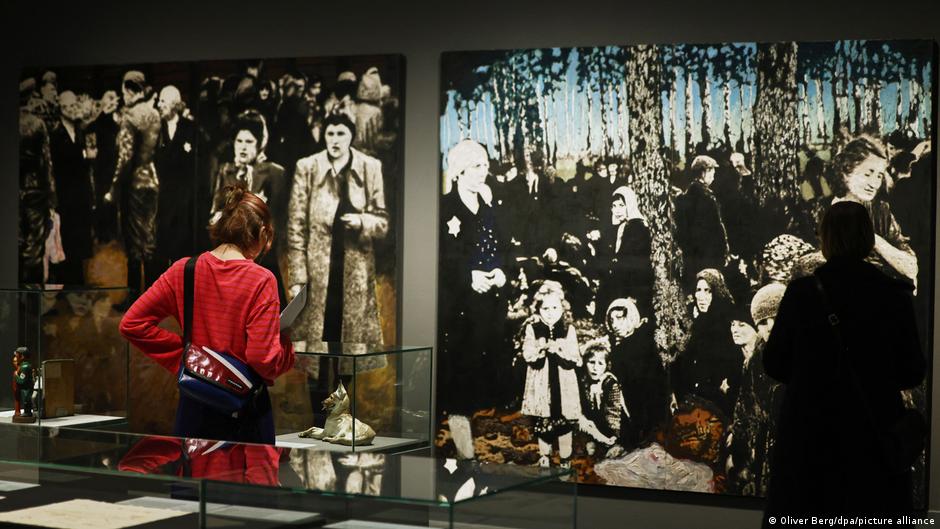
Only a few Holocaust survivors remain who can share their stories firsthand. Meanwhile, voices calling for an end to what they describe as a 'cult of guilt' are growing louder. How can Holocaust remembrance survive? Young people pose inside a crematorium oven at the Buchenwald concentration camp memorial, laughing while they give the Nazi salute and take pictures of each other. Jens-Christian Wagner, director of the Buchenwald and Mittelbau-Dora Memorials Foundation, told DW, 'In a sense, they're trophies to post on social media for them to boast about — breaking the ultimate taboo.' Wagner is part of the curatorial team behind the exhibition 'Never Again! Against Forgetting the Crimes of the Nazi Regime' in Bonn's Bundeskunsthalle. Wagner says that Holocaust remembrance is under pressure, and the subject of intensifying attacks. Critics have dismissed remembrance as a 'cult of guilt' or 'national masochism.' With right-wing populism on the rise and historical revisionism becoming more common, Wagner worries about how Germany will remember the victims murdered by the Nazi regime. He is also concerned about the future of democracy. And soon, there will be no Holocaust survivors left to tell the true story of what happened. The new exhibition tackles this concern head-on with numerous works of art and historical artifacts. Memorial sites also attract visitors who aren't necessarily convinced of the need to confront these parts of history. Many of them are students. Buchenwald organizes full-day programs that allow students to explore historical sources together and make sense of history for themselves. Visitors are encouraged to make connections between the past and current events like migration, for example. Eva Umlauf knows firsthand what it means to experience exclusion in its most extreme form. She is a patron of the Bonn exhibition. Now, she's 83. But in November 1944, she was just two years old when the Nazis deported her, her pregnant mother and her father from the Novaky labor camp in Slovakia to Auschwitz-Birkenau, the notorious Nazi concentration and extermination camp. She was saved from the gas chambers by mere days; the Nazis stopped using them as the Red Army advanced, hoping to hide evidence of their crimes. The camp was liberated on January 27, 1945. Three months later, Eva's sister Nora was born. But her father, her mother's siblings and her grandparents were all murdered. Eva barely survived herself. She suffered from tuberculosis, rickets and whooping cough, as well as edema caused by starvation. 'Forget about the child. She won't survive,' a doctor told her mother. But he was wrong. Her mother returned to what was then
Ver más en News Today