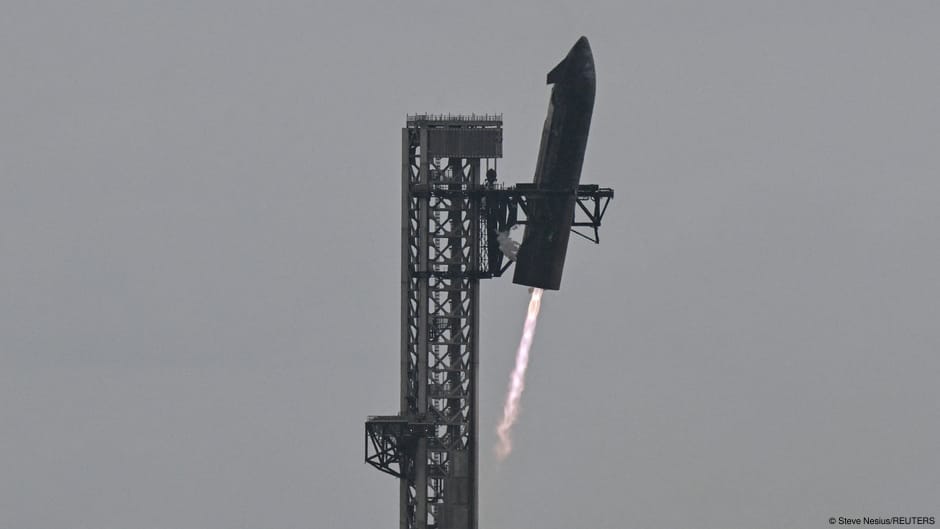
SpaceX's Starship spacecraft returned from its longest-yet flight in orbit on Saturday to the tower it was launched from on Friday. The spaceship descended and smoothly slipped between the mechanical 'chopstick arms' above Launch Pad 2 in the US state of Texas. It was the first key recovery of the rocket system's centerpiece vessel in the company's decadelong effort to develop a fully reusable rocket. 'Can you believe it?' SpaceX commentator Dan Huot shouted. 'Look at her! Baby, she’s back!' It was the 15th test flight of the world's biggest and most powerful rocket system. The Starship spacecraft orbited Earth 14 times for over 22 hours, during which it deployed 26 Starlink satellites. The successful return marked a key milestone in the multibillion-dollar development of Starship, which billionaire Elon Musk sees as crucial to SpaceX's satellite business and ambitions to put humans on the Moon and eventually Mars. 'It was almost magic,' NASA Administrator Jared Isaacman wrote on X. SpaceX also intended to capture the bottom part of the rocket, known as the Super Heavy booster, but the lower stage recovery was aborted, and it exploded over the Gulf of Mexico shortly after launch on Friday. SpaceX's Kate Tice said its engines stopped firing too soon. The booster's guidance system sensed it was not in the correct position and initiated the self-destruction protocol. Engineers are still investigating the cause.
También lo cubren: France 24 (English), Latest articles - The Japan Times, NPR Topics: News, News - The Japan Times, News Headlines, South China Morning Post (China), The Japan Times, The Times of India y otros.
Ver más en NewsToday