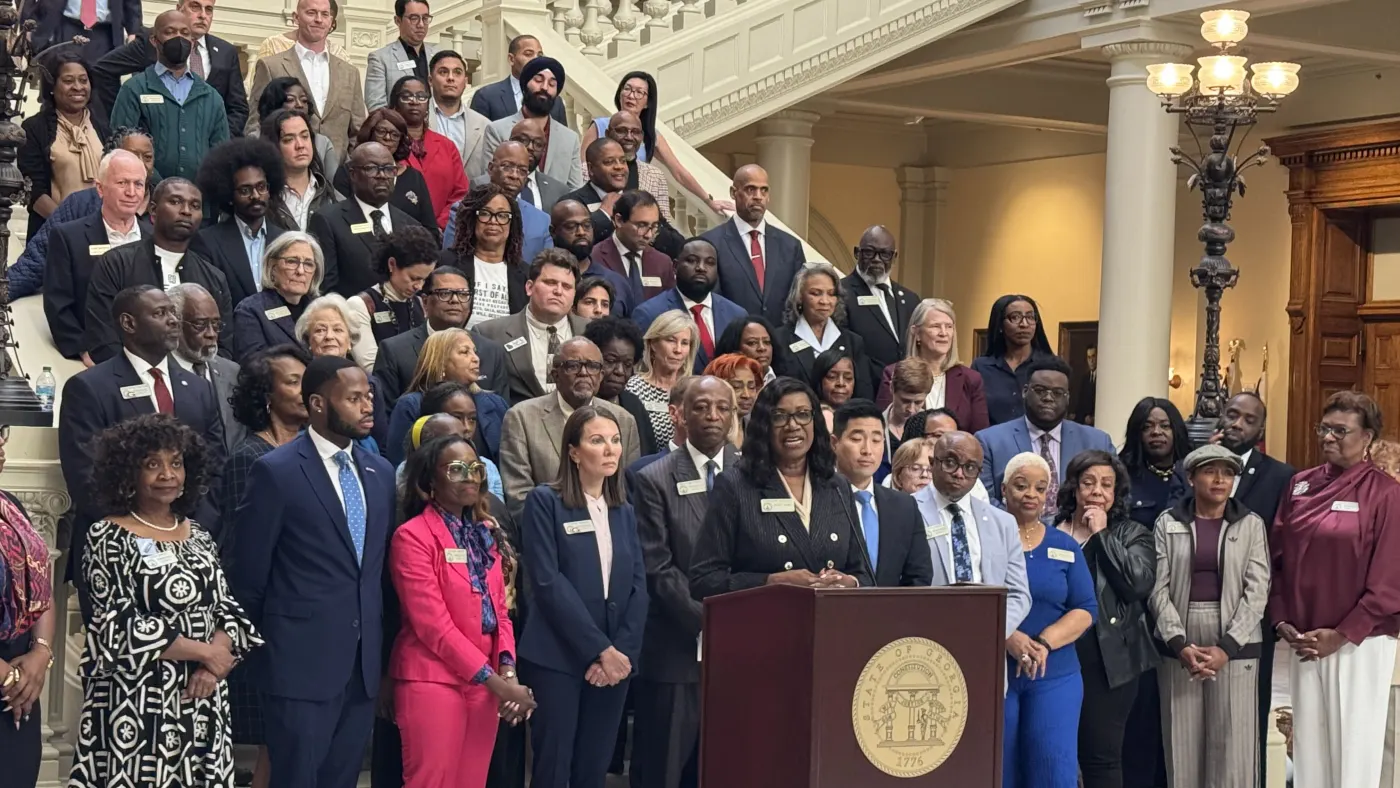
The midterm elections saw historic changes in state legislatures. Pennsylvania voters elected a Democratic majority in the state Senate for the first time since Jimmy Carter was president. Democrats in Texas will run the state House there for the first time in 24 years. The Georgia House will have a Democratic majority for the first time in more than 20 years. The results reversed a GOP dominance in legislatures that began in 2010 and had solidified since. Going into the midterms, Republicans controlled legislatures in 28 states and Democrats held 18. The remaining few were divided. Now, with some votes still being counted, it looks likely the Democrats will hold a 24-to-22 lead with others divided. So far, Democrats have picked up seats in nearly every state that held legislative elections, according to data compiled by NPR. Democrats gained significant ground in unexpected, reliably Republican states, like Texas, Utah and Florida. The shift could mean real change in people's lives as legislatures rewrite laws on taxes, reproductive rights, access to health care, school funding and other issues. Legislatures have also been important in promoting or blocking President Trump's agenda. The Republican State Legislative Committee, which coordinates support for GOP candidates, blamed the losses on the national anti-incumbent mood and heavy spending for Democrats. 'Ultimately, the results of this cycle underscore both the challenges Republicans face and the importance of maintaining a strong, sustained presence in the states,' the group's president. Edith Jorge-Tuñón, wrote. The president of their rival organization, Heather Williams of the Democratic Legislative Campaign Committee, said their wins 'proved what is possible when you put statehouses at the center of a national strategy.' Some of the biggest changes could come in states where Democrats now control both chambers of the legislature and the governor's office. They gained six new 'trifectas.' In Arizona, Democrats will have the majorities in the state House and Senate and hold the governor's office — a trifecta — for the first time since 1966. One possible policy change could be on school vouchers. Gov. Katie Hobbs has repeatedly tried to reform and limit the state's billion-dollar voucher program, which provides public money for private school tuition regardless of family income. But the Republican-run legislature had blocked her. Arizona Democrats have said they also hope to provide financial relief on rent, utilities and childcare. In Pennsylvania, Democratic Gov. Josh Shapiro has promised to work with a newly Democratic legislature to raise the minimum wage to $15 an hour, strengthen abortion rights and increase affordable housing. Democrats also won trifectas in Michigan, Minnesota, Wisconsin and in Nevada, where they won the governor's office. They broke Republican trifectas in Georgia, Iowa, New Hampshire, Ohio and Texas. Going into the midterms, Republicans had a few more trifectas than the Democrats. Now Democrats will likely have 22 and the Republicans 17, with 10 other states divided, according to the National Conference of State Legislatures. (That doesn't include Nebraska, with a Republican governor and a unicameral legislature controlled by Republicans.) In some states, including Georgia, North Carolina and Texas, Democrats have turned Republican-controlled legislatures into divided legislatures. Georgia Democrats won the House and came close in the Senate. On their agenda, they could try to win over a few GOP lawmakers and pass Medicaid expansion to provide health care to more low income residents. There could also be an effort by House Democrats to repeal that state's six-week abortion ban, but that could be a tough sell in the Senate.
También lo cubren: NPR Topics: News.
🔗 Leer la noticia completa en npr.org - NPR Topics: Home Page Top Stories
Ver más en NewsToday