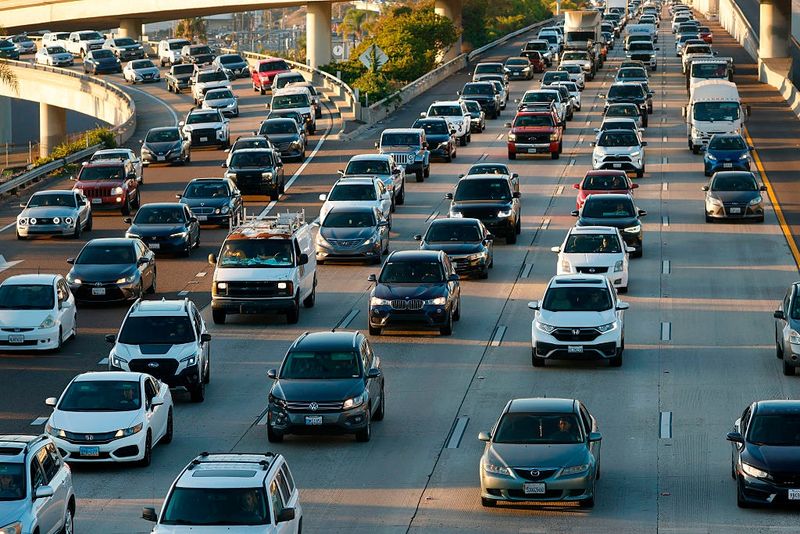
Tackling traffic congestion is one of the biggest challenges facing large cities around the world. When it comes to reducing congestion, one solution almost instinctively comes to mind: build more roads or widen existing ones. But the science of transport economics has shown for decades that increasing road capacity does not necessarily translate into smoother traffic. In fact, under certain conditions, it can do the opposite. Let’s start with a very simple road network. Suppose everyone in a town lives at the same origin (the start) and travels each morning to the same destination (the finish). There are only two possible routes between them: the first route goes from the start to point A, then from A to the finish; the other goes via point B instead. The roads from the start to B and from A to the finish are nice and wide, and take a constant 45 minutes regardless of traffic. The roads from the start to A and B to the finish are narrower. They take five minutes without traffic, but every 100 cars on the road adds an extra minute to the trip. During the morning peak, 4,000 drivers go from the start to the finish each day. The question is: how do the 4,000 commuters distribute themselves between the two routes? Transport scientists answer this using the concept of traffic equilibrium. A road network is in equilibrium when no commuter can reduce their travel time by changing routes. If one route is quicker, some drivers would switch to it. That movement would continue until no driver could improve their journey by choosing differently. In our simple network model, the equilibrium is straightforward to calculate. It occurs when 2,000 commuters use each route. In this situation, each wide road (from the start to B and from A to the finish) takes 45 minutes, and each narrow road (from the start to A and from B to the finish) takes 25 minutes. So, each route takes 70 minutes in total to complete. Now suppose the city builds a new one-way road connecting A to B. It takes just ten minutes to traverse, no matter how many people use it. Commuters now have three routes to choose from instead of two: they can travel from the start to A to the finish, from the start to B to the finish, or the new route from the start to A to B and then to the finish. It seems difficult to imagine how this could make anyone worse off. But remember how drivers choose their routes. They are not trying to minimise congestion across the network. They are trying to minimise their own travel time. After the shortcut is built, if most drivers stick to the original routes but one driver uses the shortcut (travelling from the start to A to B and then the finish), that one driver can do the whole trip in 60 minutes (25 minutes from the start to A, 10 from A to B, and 25 from B to the finish). However, when many drivers use the shortcut the congestion levels change significantly. The network eventually settles into a different equilibrium. Half of all commuters (2,000) now use the new route, while the remaining commuters split evenly between the two original routes. As a result, the two congestion-prone road segments each carry 3,000 commuters instead of the previous 2,000. As a result, every route now takes 80 minutes to complete – ten minutes longer than before the new road was built. The paradox could be avoided if commuters coordinated their decisions and agreed not to use the new connection. With 2,000 commuters on each original route, everyone would again complete the journey in 70 minutes. This is called the system optimum or social optimum: the traffic pattern that minimises total travel time across the network.
También lo cubren: dailymaverick.co.za - Daily Maverick - Latest News.
Ver más en NewsToday